
UK/EU Master's Personal Statement & Motivation Letter Rubric
Tailored for taught master's applicants in the UK and EU, this rubric assesses the coherence and conviction of the applicant's motivation, the depth of their academic preparation, the alignment between their profile and the chosen programme, the strength and specificity of supporting evidence, and the clarity of their forward-looking vision (600–900 words).
- Dimensions6
- Score Range0–5
- Word Count600 - 900
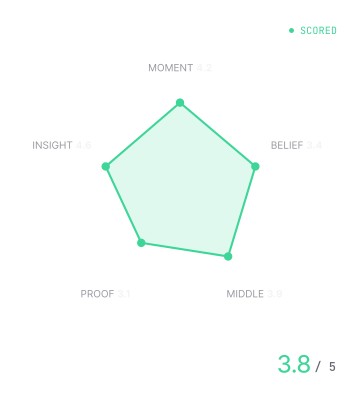
Would your draft pass this rubric?
Check what's true of your current draft. Be honest, the reviewer will be.
- I can point to one specific occasion where it started, not a season, year, or era
- My draft names a belief or behavior I held before, and what replaced it
- There are visible attempts or setbacks between the event and the lesson
- My new understanding is specific enough to quote, it couldn't close someone else's essay
- At least one concrete action after the growth period proves it stuck
Signal building. Over halfway — the missing dimensions are the ones readers weigh hardest.
Get the real scoreWhat Reviewers Look For:
UK/EU Master's Personal Statement & Motivation Letter
Clarity and Conviction of Motivation
Evaluates whether the applicant articulates a genuine, specific reason for pursuing this degree at this stage of their life, and whether that reason is internally coherent rather than generic or performative. Strong responses connect a concrete intellectual or professional trigger to the decision to apply.
Academic Background and Preparedness
Evaluates whether the applicant demonstrates the disciplinary knowledge, analytical skills, and prior coursework or research experience necessary to succeed in a taught master's program. Strong responses cite specific modules, methods, or academic outputs that directly map onto the program's demands.
Programme Understanding and Personal Fit
Evaluates whether the applicant shows evidence of having researched the specific program, including modules, faculty, or institutional strengths, and whether they explain why this program — not a generic master's — serves their goals. Strong responses name particular program features and connect them to stated objectives.
Evidence, Specificity, and Credibility
Evaluates whether claims about skills, achievements, and experience are supported by concrete, verifiable details rather than self-description. Strong responses use named projects, measurable outcomes, institutional contexts, or dated experiences to substantiate every significant claim.
Concision, Structure, and Readability
Evaluates whether the essay uses its word count efficiently, with each paragraph advancing a distinct point and no padding, repetition, or over-qualification. Strong responses stay within the 600–900 word prompt constraint while covering all required dimensions without sacrificing depth.
Future Aspirations and Potential Contribution
Evaluates whether the applicant articulates a plausible post-degree trajectory — professional, research-based, or civic — and whether this trajectory is logically connected to what the program offers. Strong responses are specific about sector, role, or problem domain rather than gesturing at vague impact.
Concise German Motivation Statement — LMU, KIT & Comparable Portals
Tailored for German master's application portals such as LMU, KIT, and equivalent platforms: a focused, evidence-grounded motivation statement that adheres to strict character constraints (2,000–3,000 characters) and is composed entirely in plain text.
6 DIMENSIONS300-500 WORDSOpen rubricMaster's Motivation Letter — Netherlands (Standard)
Crafted for master's applications at Dutch universities: a lucid, evidence-grounded motivation letter that articulates a compelling alignment with the chosen programme, well-defined professional aspirations, and the direct, substantive communication style that Netherlands admissions committees value.
6 DIMENSIONS500-1000 WORDSOpen rubricAcademic Statement of Purpose — LSE
For LSE and comparable UK programmes requiring a minimum of 80% academic content: demonstrate intellectual depth, rigorous critical engagement with your discipline, and a compelling alignment with the specific programme, within 1,000–1,500 words.
7 DIMENSIONS1000-1500 WORDSOpen rubricTU Delft Research Master's Motivation Letter
Tailored for TU Delft master's programmes: a carefully structured motivation letter that articulates proposed thesis projects, distils the applicant's BSc thesis with precision, and presents a compelling rationale for their chosen specialisation — demonstrating genuine readiness for rigorous research and a well-grounded sense of intellectual self-assurance.
7 DIMENSIONS1000-1500 WORDSOpen rubricNL Scholarship Personal Motivation Letter
For the NL Scholarship (formerly the Holland Scholarship): craft a persuasive and well-considered case for your distinction as a student by illuminating your academic achievements and the meaningful impact of your extracurricular pursuits, within 500 words.
6 DIMENSIONS300-500 WORDSOpen rubricMaster's Motivation Letter — Dutch Concise Edition
A rigorously distilled motivation letter crafted for Dutch universities that impose strict word limits: each word must justify its presence, the argument must remain sharply focused and free of superfluous content, and the letter must fall precisely within a 300–500 word count.
6 DIMENSIONS300-500 WORDSOpen rubricMaster's Motivation Letter for German Applications (Motivationsschreiben)
Tailored for candidates pursuing master's programs at German institutions: a clear, evidence-grounded motivation letter that articulates program fit, academic preparedness, professional aspirations, and a considered rationale for choosing Germany.
7 DIMENSIONS300-1000 WORDSOpen rubricMaster's Statement of Purpose for Professional Programs
Crafted for candidates pursuing career-focused master's programs, this rubric evaluates the clarity of professional objectives, the applicant's self-aware identification of skill gaps, the coherence of their alignment with the program, their demonstrated readiness to thrive, and the distinctive value they bring to the cohort.
7 DIMENSIONS1000-1200 WORDSOpen rubricStatement of Purpose for MFA and Creative Programs
Designed for candidates pursuing MFA and creative master's programs, this rubric evaluates the full arc of the artistic statement: the clarity and conviction of creative intent, the depth and distinctiveness of one's practice, the context and evolution reflected in the portfolio, alignment with the program's creative community, the authenticity of artistic voice, and the coherence of a forward-looking creative vision.
7 DIMENSIONS1000-1200 WORDSOpen rubricMaster's Statement of Purpose
A Statement of Purpose is a defining document required by most Master's programs, through which you articulate your scholarly motivations, intellectual trajectory, and the aspirations that compel you toward graduate study.
8 DIMENSIONS1000-1200 WORDSOpen rubric
Frequently asked questions
Quick answers about using the UK/EU Master's Personal Statement & Motivation Letter rubric.

Give the draft one more informed pass
Review the draft against its prompt, surface weak spots, and decide what to revise before submission.
Review your first draft