
University of Pennsylvania DSW Application Essays Rubric
For the Doctor of Social Work in Clinical Practice program at the University of Pennsylvania School of Social Policy & Practice. Applicants are required to complete three essays of approximately 500 words each, engaging with questions of personal motivation, clinical case analysis, and a proposed area of doctoral inquiry.
- Dimensions7
- Score Range0–5
- Word Count1400 - 1600
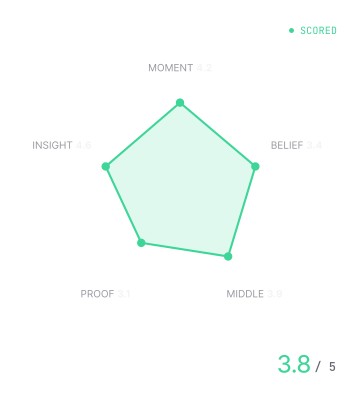
Would your draft pass this rubric?
Check what's true of your current draft. Be honest, the reviewer will be.
- I can point to one specific occasion where it started, not a season, year, or era
- My draft names a belief or behavior I held before, and what replaced it
- There are visible attempts or setbacks between the event and the lesson
- My new understanding is specific enough to quote, it couldn't close someone else's essay
- At least one concrete action after the growth period proves it stuck
Signal building. Over halfway — the missing dimensions are the ones readers weigh hardest.
Get the real scoreWhat Reviewers Look For:
University of Pennsylvania DSW Application Essays
Opening Statement: Motivation, Readiness for Doctoral Study, and Fit with Penn
Evaluates whether the applicant articulates a specific, experience-grounded rationale for pursuing doctoral-level clinical training and demonstrates awareness of what distinguishes DSW from other advanced degrees. Strong responses situate the decision in a named clinical or professional turning point and explain why doctoral inquiry is the necessary next step.
Clinical Reasoning and Conceptual Framework
Evaluates whether the applicant demonstrates command of a theoretical or practice framework and applies it consistently to explain their clinical decision-making. Strong responses name and correctly deploy a framework, showing that clinical choices are principled rather than intuitive.
Professional Judgment and Ethical Decision-Making
Evaluates the applicant's capacity to navigate clinical complexity, competing obligations, and ethical tension with appropriate reasoning. Strong responses name the competing considerations explicitly and demonstrate a deliberate, defensible decision-making process rather than a formulaic or retrospectively tidy account.
Doctoral Inquiry and Contribution to Knowledge
Evaluates whether the applicant has formulated a meaningful, researchable area of inquiry and can articulate how it would contribute to clinical social work knowledge. Strong responses name a specific population or practice gap, gesture toward a method or question, and explain why the contribution matters beyond their own clinical setting.
Demonstrated Readiness for Clinical Practice
Evaluates whether the applicant demonstrates sufficient direct clinical experience to engage doctoral-level advanced practice training, including comfort with ambiguity, supervisory feedback, and evolving case conceptualization. Strong responses show accumulated practice wisdom that is self-aware about its limits.
Alignment with Penn's Mission and Program Values
Evaluates whether the applicant demonstrates knowledge of Penn SP2's specific faculty, research concentrations, or programmatic emphases and explains a credible intellectual or professional alignment with them. Strong responses name specific Penn resources or scholars and explain how they connect to the applicant's stated inquiry or clinical population.
Consistency and Coherence Across All Three Responses
Evaluates whether the three essay responses form a unified intellectual and professional narrative rather than three isolated answers. Strong responses share consistent terminology, build on the same clinical population or theoretical commitments, and allow the doctoral inquiry response to feel like the logical destination of the motivation and clinical case responses.
PhD Research Proposal & Statement of Purpose
Tailored for research doctorate applications in which the defining evaluative signals are the intellectual viability of the proposed inquiry, the candidate's alignment with a prospective supervisor, and the logical rigour of the proposed execution plan.
8 DIMENSIONS1200-2200 WORDSOpen rubricProfessional Doctorate Personal Statement (EdD/DBA/DNP/PsyD)
Tailored for candidates pursuing a professional doctorate, this rubric assesses the clarity and sophistication of problem-of-practice framing, the depth of leadership impact, the viability of the proposed project, and the coherence of alignment with the selected program.
8 DIMENSIONS1000-1500 WORDSOpen rubricPhD Statement of Purpose
A Statement of Purpose crafted for doctoral program applications, articulating your research background, theoretical orientations, intellectual alignment with prospective faculty, and capacity to advance original scholarship within your discipline
8 DIMENSIONS1000-1200 WORDSOpen rubric
Frequently asked questions
Quick answers about using the University of Pennsylvania DSW Application Essays rubric.

Give the draft one more informed pass
Review the draft against its prompt, surface weak spots, and decide what to revise before submission.
Review your first draft